build.bvmcontracting.com

Blog

  • How to Keep Home Addition Costs Low

    How to Keep Home Addition Costs Low

    How To Keep Home Addition Costs Low

    Whenever people first look at completing a home addition, they often are surprised to see the magnitude of total project costs. A home addition in Toronto (based on our own pricing and budgeting in 2022/2023) can easily range anywhere from $400 000 – $800 000 (taxes included), depending on:

    • The amount of the existing house being renovated

    • How much additional square footage is being created

    • What the existing conditions of the house are

    • What the starting square footage of the house is.

    Since the range provided above is so variable it is always recommended to submit your home’s property information to us so we can start the process of giving you a budget for your project. There are many different types of homes in Toronto and many different client needs, which is why we created our renovation consultation service. By completing our renovation consultation will be able to get a better idea of what your realistic costs will be for your project BEFORE you commit to completing the design and permitting. We would rather be honest upfront and let you wait to do the project properly than string people along.

    Through our experience pricing out home addition projects in Toronto, we have narrowed down the key areas you should focus on to keep costs lower for your project. Take a look below and if you have any additional questions we welcome you to reach out!

    Home Addition Cost Saving Ideas

    Cost saving Idea 1: Involve a Home Builder or General Contractor in the design phase

    This idea is simple but powerful. Why wouldn’t you try to involve a Home Addition Contractor in the design phase if they are the ones who will be pricing out the project? The earlier in the design process they can get involved, the sooner you can pivot away from costly design details. The fact of the matter is your architect or designer working with you on your permit submission drawings will not know the costs of your project from beginning to end, no matter how handy they are. So get an experienced home addition team with the estimating and budgeting experience involved in the design phase as soon as possible!

    Cost saving Idea #2: Top-up versus extension

    There are essentially two ways you can add more space to your existing home – horizontally or vertically. If you have the ability to just build on top (vertical) of your existing home, that will trim the budget versus doing the same amount of square footage with an extension (horizontal). The reason for this has to do with the additional steps involved in completing an extension, you have to create a new foundation that usually comes with intensive excavation and foundation prepwork. Extensions being included as part of a home addition are not always avoidable depending on your needs, but it is something to consider. There are other ways to maximize a top-up addition project, like completing a cantilever, that can be explored versus completing an extension as well.

    The only exception to this rule is if you are completing underpinning work in your basement, there may be some efficiencies that come with completing a rear extension in this scenario due to the ability to machine dig the basement versus a manual dig. This is on a case-by-case basis so reach out to us to discuss.

    Cost saving Idea #3: Keep existing brick cladding for main level intact and Exterior finishes

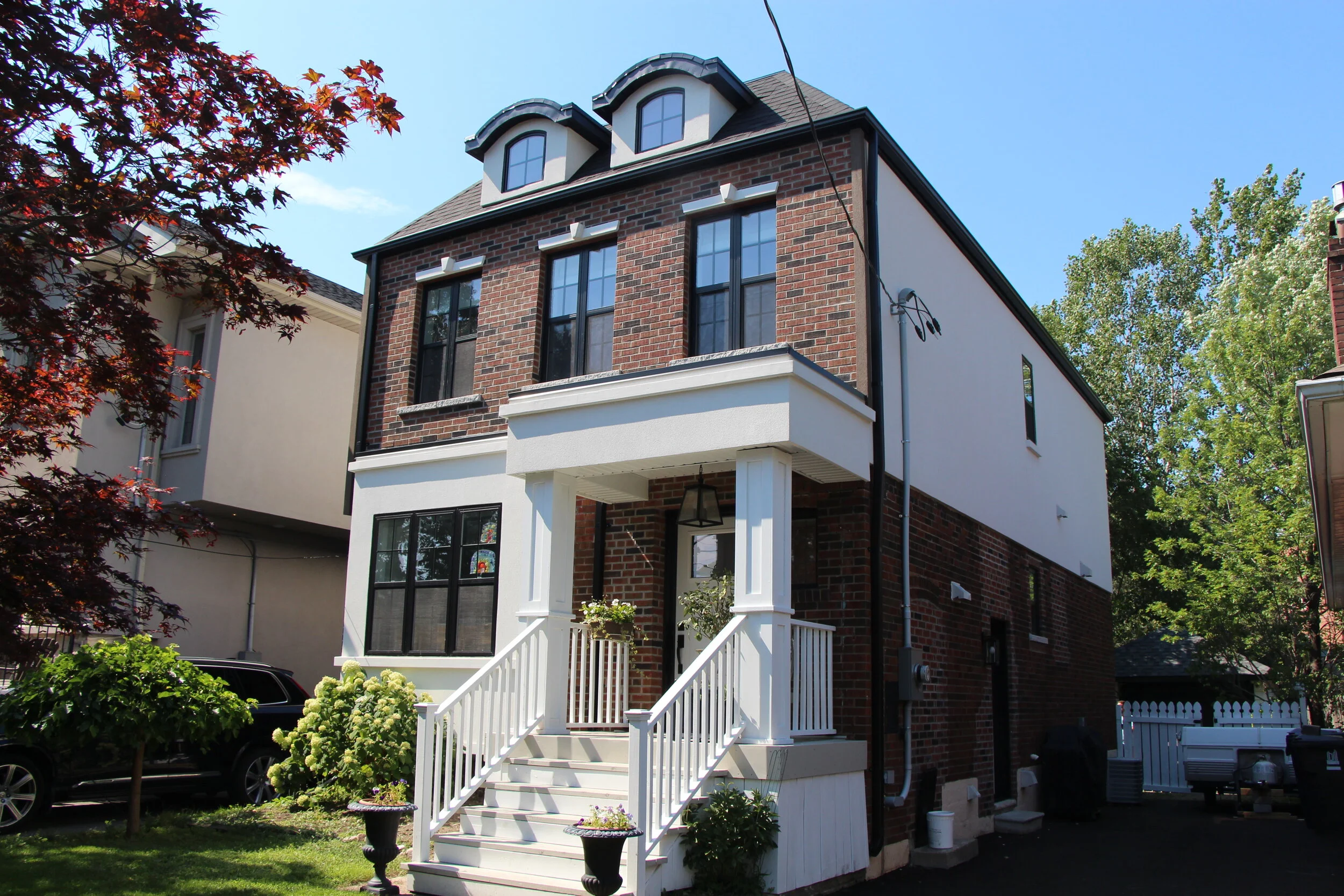
    If you take a look at our page that goes into detail about the different types of home additions you will see a before and after picture of one of our home addition projects that maintained the existing brick on most of the main level of the home (which started as a bungalow). We were able to get a brick match for the second level and the outcome can speak for itself. The exterior finishing costs for this were substantially reduced because less surface area was affected.

    Even if you are planning on recladding everywhere, it is important to use materials that are not super costly, and work with both your Designer and General Contractor to come up with a finish that does not break the bank.

    Cost Saving Idea #4: Basement refinishing and Renovations

    Many times when people are planning substantial renovations and home addition projects, they try to get everything done at once. There are certain benefits to doing it this way, but if you are trying to be cost-conscious with your home addition it would be a good idea to reduce the overall square footage of the existing house being renovated. An easy way to do this is to remove any basement refinishing from your home addition scope, it will allow you to focus on your needs of why you are doing the home addition in the first place and can always be done after in a secondary project to the home.

    We have recommended this countless times to our clients and will continue to do so to help them save money.

    Cost-saving idea #5: Salvaging existing HVAC equipment

    If you have recently invested in a furnace, air conditioner, or hot water system, these items can easily be reused for home additions, as long as they are sized properly for the new square footage and heat loss of the home.

    During the design phase you will need to obtain an HVAC design that will give a heat loss calculation for sizing your furnace and AC systems. If the BTU/hr (for your furnace) and tonnage (of your air conditioner) is higher than the numbers listed you should be able to salvage them.

    Cost Saving idea #6: Salvaging finishes from your existing home

    This is probably an unpopular opinion across the board for many General Contractors, but with the rise of the circular economy in residential construction it is worth noting. If there is anything in your existing home that you are looking to salvage (whether that be kitchen cabinets, door handles, lighting, doors, etc.) you should make sure you can allocate some time to coordinate getting them safely removed from the home to be either reused in your new home or sold.

    Just note that if you are planning on reusing fixtures that the onus will be on you to make sure they are stored safely and have all of the hardware needed to be reinstalled.

    We have helped clients create a section of their scope that includes salvaging with great success, but need to be some level of involvement from the client in order to make it happen.

    Cost Saving Idea #7: Plumbing Fixture locations

    When designing your home it is important to note that the closer plumbing fixtures are to each other (both horizontally and vertically) the more efficient the plumbing work will be. For example, if there is a way to have a common wall between your ensuite bathroom and second bathroom on your second storey addition, then you should try to make that work. Even better, if the bathrooms are located above the existing plumbing stack for the home it will make a plumber’s job way less labour intensive.

    Cost Saving Idea #8: Sourcing your own finishes

    This is something we allow all of our clients to do, and it saves them quite a bit of money because we are not charging extra to source finishes on their behalf (which other General Contractors and Home Builders do). We pass along any contractor discounts to our clients with our preferred list of vendors, which allows them to save even more money. The dual benefit of this is it allows the clients to feel more involved in the home addition process.

    Cost Saving Idea #9: Completing Portions of the project yourself (DIY)

    Many times our more handy clients ask us if they can take on portions of the project that they have prior experience with. This has included tiling, trim/door installations, flooring, and painting. We understand that labour is not cheap with many trades, so for the clients that have the time, experience, and patience this is a quick way to save a bunch of money.

    Just note that we only allow our clients to take on work AFTER the Drywall Finishing stage, any work before will need to be completed by BVM-managed subcontractors. This is to prevent any delays in the work and to ensure quality behind the walls.

    Cost Saving Idea #10: Reduce the Amount of Tiled surfaces

    The cost to supply and install tile can range between $20-30 per square foot, whereas with hardwood you would be around the $10-15 per square foot range. Compare that to vinyl (which would come in around $6-8 per square foot) and your savings from swapping out your finished flooring material can be substantial!

    Cost Saving Idea #11: Trusses versus hand-framed roofs

    Lumber is an obviously expensive line item nowadays with home additions and home building projects across Toronto, but so can the labour portion of framing if you are not careful. The one thing you can do with the lumber line item that can save you money is designing the roof system so that trusses can be installed, versus having to hand frame the roof.

    Cost Saving Idea #12: Reduce or remove Steel beams

    This is not always avoidable depending on your design, but if you care a lot about costs it would be best to have your designer or architect design your home addition with the intention of reducing or avoiding steel beams wherever possible.

    Conclusion

    These are just some of the more popular ideas that we have come up with clients and designers to reduce the overall cost of a home addition project during the design phase. We always recommend getting ourselves involved during the design process, it is a bunch of work but is worth it for us and the client.

    Before you get to the design phase, make sure you get in contact with a reputable General Contractor that will be able to help get you a representative budget so you can make sure you can afford the work before spending money on a design you can’t afford. Better yet, you can also find out if your home is a good candidate for a home addition by reading our blog on the topic.

    About BVM COntracting

    BVM Contracting is a full-service General Contractor or Home Builder located in Toronto. We provide home renovation and building services for major home renovations (kitchen renovations, bathroom renovations, basement renovations, full interior renovations, home additions, lot severances, and new home construction). Our goal is to help guide our clients through the process of renovating their home, from concept to completion.

    Further than providing General Contracting and Project Management for major home renovations, we also offer value-added services such as renovation financing, renovation rebate consultations and services, building permit and design services, smart home installation services, and real estate investor services.

    To learn more about our offering by visiting our services page.
  • General Contractors Toronto

    General Contractors Toronto

    For those of you new to residential construction, the Term “General Contractor” may seem a little ambiguous and foreign to you, and you are not wrong. The term General Contractor is used in a wide variety of industries to define a company that is hired to complete a multi-disciplinary project by contracting out and managing the work set out in the project scope.

    Narrowing this down to residential construction, this defines a company that manages a multi-disciplinary project for a home. This could be a smaller project like a basement renovation, all the way up to a custom home build or home addition. Irrespective of the size the project presents a unique list of project requirements that cannot and should not be completed all by one person, there needs to be multiple companies that are contracted (i.e. subcontractors) to complete certain sections of the work to ensure the residential construction project is completed properly. A General Contractor ensures that the right subcontractors are hired and manages the project from beginning to end, working with the home owner (i.e. the client) to deal with project logistics, selections, timelines and ultimately controlling costs (and mitigating cost overruns) to deliver a project that is on time and on budget.

    In layman’s terms, the role of a Residential General Contractor in Toronto is to plan, execute, and manage a complex renovation or home building project on behalf of the client (i.e. the home owner or investor) to ensure that the project comes in on time and on budget.

    When looking for a General Contractor to hire in Toronto, here are some common avenues to look through:

    • Referrals – If you know a friend or family member who has completed a home renovation, home addition, or custom home build in Toronto and their project went well you should ask for the General Contractor’s Information

    • Google Search – Many reputable General Contractors in Toronto have a good online presence and informative websites to review their capabilities. We have about 50-60% of our business each year come from completely new clients that were not referred to us by previous customers. They either found us online or through one of our social channels.

    • Local General Contractors Near Me – Is there a General Contractor in your neighbourhood right now completing a project? Or one that lives near you? If so don’t be shy and ask for a business card or take a picture of the marketing material they have on the project site. Many of our past clients have done this and were also able to tour through the project site as well. This method is how we have gained many clients because they can see how the existing project progresses to see the speed, quality, and professionalism of the company.

    • Company Vehicles – chances are if you keep seeing the same company driving up and down the streets that you do that they are local to that area of the City. A little known fact that should be more well known is that service businesses tend to want to work more in their own backyards so if they live and work near you chances are you will get better communication, better pricing, and overall a better experience dealing with a General Contractor near you.

    If you are dealing with a reputable General Contractor in Toronto here are some minimum expectations you should have as a home owner/investor:

    • Prompt Communication – Chances are if you are hearing from your General Contractor every other day or once a week they are not set-up to communicate effectively during your project. Make sure who you are dealing with is responsive and can actually help you through the process, that is what a General Contractor is there for!

    • Honest Advice and Transparency – If your General Contractor is not challenging you and giving you real advice for your project then they are not doing your project justice. Planning is 75% of the work with home renovations and home builds so if they are not putting in the work and engaging with your idea then drop them then and there. Walk away from the “take it or leave it” General Contractors, your project will not end well.

    • Step-by-Step Guidance – If Everest Peak is your project’s finish line then think of your General Contractor as your guide who has made the trek dozens (if not hundreds) of times. Lean on your General Contractor to figure out your next best step in the planning and home building process because chances are they have the experience to guide you through whatever comes your way before, during, and after the project.

    • Preliminary Budgeting Review – If you are just starting to plan your renovation or home building project you should be working with a reputable and knowledgeable General Contractor that can provide you with a realistic budget for your desired project. They should have the experience to estimate your project’s costs with or without preliminary plans (although having plans is more accurate), and actually give you a breakdown of costs.

    • Professional and Detailed Scope of Work – If your General Contractor is not willing to give a budget breakdown for all of the steps involved in a home renovation, home addition, or home building project, then drop them. There are too many opportunities for cost savings at every step of a project and if they aren’t willing to work with you to try to reduce costs then they are not the General Contractor for you.

    • Warranty – Having a warranty is one thing, but actually fulfilling it is another. It is important to have the peace of mind knowing that anything that goes wrong after the contract is completed will be covered for a certain duration after the project. We will get into this in the next section in a bit more detail.

    • In-house TeamA General Contractor that has an internal team that can help keep projects moving between all of the difference subcontractors is very important. A GC with an in-house team is able to complete your project more efficiently than a project manager managing your home renovation, home addition, or custom home build.

    The following list outlines what you will want to ask for from a Residential General Contractor in Toronto. Fulfilling this list will mean that you have a high degree of certainty that you are dealing with a company that will be able to complete your project on time and on budget.

    1. Renovation or Home Building Contract – The sooner you can review the better so ask for it once you get the budgeting process started to make sure there are no hidden clauses or contradicting information.

    2. References (very important!) – Your soon-to-be General Contractor should have no problem putting together a list of past projects/clients that are similar in scope to yours (usually we give a list of 3). Make sure you ask the past clients about how it was working with the General Contractor, if the company has been able to fulfill their warranty, if they were on time and on budget, and overall how it was dealing with the project logistics. Remember that no project goes perfectly so you should definitely ask if there were any issues (major or minor), but even more importantly what the General Contractor did to solve the issues that presented themselves.

    3. Insurance and WSIB – Make sure you ask for and review these items to make sure they are covered and no liability can be shifted to you during the project. As a side note, whenever completing renovation work always check with your insurance company to make sure you are covered in the event of fire or any other events.

    4. A fully procured project budget – This is ultimately what sets apart the reputable General Contractors in Toronto from the rest. If your GC can give you certainty that the budget that you have given them is finalized and has been reviewed by each subcontractor then you know that your General Contractor is well-respected by their subcontractors, organized, and ready to start your project! If you don’t have a budget that is procured expect increases to your overall budget over the length of the project.

    This one is very easy because they are usually one in the same! A home builder is a General Contractor that specializes in building homes. It is the same as asking if a home renovation company is the same as a General Contractor – many times they are, as long as they are dealing with multi-disciplinary projects and subcontracting aspects of the renovation project.

    This list of project types would be very long, but we have narrowed down the list to some of the more multi-disciplinary projects that are commonly completed by a General Contractor in Toronto and that BVM Contracting has completed or in the process of budgeting:

    Conclusion

    We hope that we have helped answer some questions you had about General Contractors in Toronto, if you have any additional questions feel free to reach out and we can help get your project started!

    About BVM COntracting

    BVM Contracting is a full-service General Contractor or Home Builder located in Toronto. We provide home renovation and building services for major home renovations (kitchen renovations, bathroom renovations, basement renovations, full interior renovations, home additions, lot severances, and new home construction). Our goal is to help guide our clients through the process of renovating their home, from concept to completion.

    Further than providing General Contracting and Project Management for major home renovations, we also offer value-added services such as renovation financing, renovation rebate consultations and services, building permit and design services, smart home installation services, and real estate investor services.

    To learn more about our offering by visiting our services page.

  • Tool and Equipment Rental Options in Ontario

    Tool and Equipment Rental Options in Ontario

    Tool and Equipment Rental Options in Ontario

    One of the key barriers to entry for a homeowner completing their own DIY renovation project is the lack of tools available to them. Many times it takes a variety of tools to complete even the most straight-forward of projects, and along with the material investment to complete the work, adding tools to the list of expenses is a hard pill to swallow. Especially for projects that require specific tools, it does not make sense to buy the tools outright to use them only once or twice.

    This is where tool and equipment rentals come in! Learn about the different rental options you have as a homeowner or real estate investor to help complete your own small renovation projects

    Option 1: For Small/Large Tool and large Equipment Rentals – THE Home Depot

    Having used their tool and equipment rental many times we can vouch for the ease of use and variety of options they have for tool and equipment rentals. You can rent anything from a tile cutter all the way to skid steers, and they charge you based on a minimum 4 hours of use and have options all the way up to 4 weeks.

    We recommend that people who already have the base tools (hammer, drill, screw drivers, saw, etc.) but are in need of 1-2 specialty tools for their project use The Home Depot Rental Service. If you end up renting a lot of items from them it will get pretty costly so make sure you have a game plan and budget.

    If you are utilizing The Home Depot Project Loan for your renovation project you will be able to utilize their rental service and apply charges from rentals to the project loan!

    If you find a tool or piece of equipment on The Home Depot (THD) Website that you want to rent, it is recommended to call your local THD rental desk to confirm availability and book the rental! You can find the pricing directly on their website for most tools and equipment. If you live in a large City like Toronto that has multiple locations, you can try reaching out to multiple stores to find the tool or piece of equipment you need!

    Option 2: For Larger Tools and Heavy Equipment – Battlefield Equipment Rentals

    For more industrial equipment/machines and large tools Battlefield might be the best place to look. With 35 locations across Ontario they service the larger metropolitan areas of the Province. BVM Contracting has used Battlefield pretty extensively over the last few years for our construction heating and large tool rental needs.

    Since none of their rental pricing is available online, you will need to reach out to your local dealer to determine what the availability and pricing will be for the rental you would like. Much in the same way as The Home Depot’s rental service, you will only want to rent the specialty items that you need for one-off/less frequent projects, if you end up needing a piece of equipment longer term you should explore the option of buying versus renting, depending on what the tool or piece of equipment is and how frequently you will use it.

    Option 3: Renting common renovation tools from your local tool library

    Tool Library’s in Ontario are available in many of the larger City’s and areas of the province. These tool library’s are non-profits that have an inventory of regularly-used tools that homeowners can rent for their personal home renovation projects.

    For example, Toronto’s Tool Library offers annual memberships that range from $55-$110 + HST per year and allow you different rental options, date ranges, and reduced fees on more specialty (or higher demand) tools.

    To find your local Tool Library (or to see if your area has one) you can check out this map that shows an up-to-date version of where they are located in Ontario. Plus, you are supporting a great local non-profit that is giving back to your community!

    Option 4: Borrow Friends and Family’s Tools

    One of the most common and cost-effective methods to get tools is to borrow from friends and family. Many times there is a friend or family member with a large tool catalogue that may be willing to give you some basic tools for your project.

    What if I have no experience using tools?

    Operating tools (specifically power tools) comes with associated risks, and if you are new to operating them you will want to proceed with caution. There is no shortage of online information on how to safely operate and use tools, and if you have more experienced friends or family members that can give you a crash course in how to operate certain tools take them up on it. The last thing you want to do is hurt yourself, so make sure you feel comfortable wielding the tools you will need to use for your project!

    When to buy versus own a tool or piece of equipment?

    The questions you need to ask yourself before deciding which way to proceed are:

    • How many times am I going to use said tool?

    • How much does it cost to rent said tool per time?

    • How much does it cost to buy said tool?

    Once you have this information the math is simple, if the number of times multiplied by the cost to rent per time is larger than buying the tool, you should just buy the tool. If you are unclear on how many times you will need to use the tool then renting will probably be the best option.

    Reach out to us with any additional questions or inquiries you have!

    Please reach out to us or leave a comment below if you have any specific questions!

    About BVM COntracting

    BVM Contracting is a full-service General Contractor or Home Builder located in Toronto. We provide home renovation and building services for major home renovations (kitchen renovations, bathroom renovations, basement renovations, full interior renovations, home additions, lot severances, and new home construction). Our goal is to help guide our clients through the process of renovating their home, from concept to completion.

    Further than providing General Contracting and Project Management for major home renovations, we also offer value-added services such as renovation financing, renovation rebate consultations and services, building permit and design services, smart home installation services, and real estate investor services.

    To learn more about our offering by visiting our services page.

  • Painting Yourself Versus Hiring Professional Painters

    Painting Yourself Versus Hiring Professional Painters

    Should You Paint Yourself or Hire Professional Painters?

    Make sure you understanding what “Painting” Entails before making a decision to do your own painting for your home renovation, home addition, or New home build.

    Painting is easily the most discussed line item when we price out Home Renovations, Home Additions, and Custom Home Builds. This is for good reason, because professional painting is expensive and if you have never hired a professional painting team before you’ve never seen the costs. At the end of the day anyone can wield a paint brush, roller, and painters tape, but being able to is only half the battle. In this article we help explain the “painting” line item in residential construction projects so you can determine if you have the time, patience, and experience to complete your own, or will need to hire a professional through your General Contractor.

    What is involved when you “Paint” a home?

    What many people fail to realize about painting is it is actually a very labour-intensive process. Not only does the act of painting take a lot of time, but the preparation process also takes a lot longer than people imagine. Not only that but there are more activities involved in the painting process than people think, see below:

    • Filling Trim and Drywall – It is often misunderstood that it is the drywallers and trim teams are responsible for cleaning up their messes. This is in part true if there are larger defects in their work, but for the most part the process of making sure that the trim and walls are smooth and free of imperfections falls on the painter. The process of doing this depends on how skilled your General Contractor’s Trim and Drywall/Taping teams are, which would be accounted for by any good painting team, because more time equals more cost.

    • Prep Work to cover any finished Flooring/Windows/Doors – Since many professional painters do most or all of their paint coats using paint sprayers, the preparation process needs to be very meticulous in order to prevent any finished areas of the home to be affected by the paint. That is why the first few days are mainly earmarked for prepping and protecting surfaces. This is another labour intensive part of the process for a painting team, and again time is money.

    • Painting Drywall, Trim, and Doors – Many times people don’t think about the fact that a painting team is also responsible for not only the walls but also the trim and interior doors being installed. Many times the painter will spray the doors and trim before they are installed, or at the very least try to paint the shoemould/quarteround before it gets installed.

    • Caulking of all trim to drywall terminations throughout the home – The caulking of the seams between the baseboard, casing, and jambs is a seldom thought-about task that happens to also fall on the backs of a painter, and adds additional time to the task of “painting”.

    Now you can see that “painting” has more to do with prep than just painting, lets progress to some other important topics.

    The Amount of Time it takes to Paint a Home

    To give you some recent numbers, this is what we have seen for the amount of time it takes to paint a custom home:

    • 4000 square feet + finished basement new home build – 4 weeks

    • 650 square foot third floor home addition + main/second floor paint touch ups – 1.5 weeks

    • 1600 square foot second floor home addition (main and second floors) with basement not affected – 2 weeks

    As you can see the amount of time varies, and square footage and duration are not always proportional. There are many other factors involved, including how vacant the home can be during the painting phase, at what point the painting can be completed in the project (to be continued below), and how dedicated the painting team is to the subject property (i.e. competing painting projects).

    When should painting be completed for a home renovation, home addition, or new home building project?

    The ideal time that painting should be completed is AFTER the completion of the drywalling/mudding and DURING the delivery of the interior doors and trim package. This allows the painters to do less prep work since the flooring is not yet installed, but also gives them access to all of the trim/doors they need to paint on site BEFORE they get installed. This is the most ideal time but it is very theorectical and doesn’t usually happen that way. Many times the painting is done as the tiling is being completed or once the flooring is completed, which presents more prep work for the painting team.

    What is the cost for getting a home professionally painted?

    For custom home building projects, you can expect to pay anywhere from $8-10 per square foot for a professionally painted home. As you can probably already tell, that adds up when you are looking at building a 2000, 3000, or 4000 square foot home. Note that these amounts usually include the supply of paint, and pricing will vary depending on the factors explained above.

    Is it recommended to complete your own painting?

    The Do It Yourself Painting question can only be answered with a series of follow-up questions, if you can answer yes to all of them then it is definitely possible, but make sure you are ready for a tedious and time-consuming affair.

    • Do you have any experience with painting preparation, painting, and caulking?

    • Do you have 40-60 hours per 1000 square feet to allocate for the painting your home?

    • Do you have more than one person who is willing to help you paint your home?

    The major factor at play with doing your own painting is the overall amount of square footage that needs to be painted. A lot of the time our home renovation clients can get away with doing their own painting, but our larger custom home clients have almost never picked up their own paint brush. Again – Time is Money!

    Hiring your own Painter

    In the past we have been flexible with our clients and have shifted the painting to be client-managed versus BVM-managed, but this is only recommended if you know someone who can do a good job and also provide some level of discount to complete the work. With painters, time is money so chances are if you are getting too good of a deal the product will show for it so be wary of that fact.

    Conclusion

    The key takeaway from this article is to show the the reason why professional painting is expensive, why you should not try to hire the cheapest painters, and when you should feel comfortable doing your own painting work. Hopefully this has given you a bit of an appreciation for the subtle art of residential painting, and you can make the right choice for your residential construction project!

    About BVM COntracting

    BVM Contracting is a full-service General Contractor or Home Builder located in Toronto. We provide home renovation and building services for major home renovations (kitchen renovations, bathroom renovations, basement renovations, full interior renovations, home additions, lot severances, and new home construction). Our goal is to help guide our clients through the process of renovating their home, from concept to completion.

    Further than providing General Contracting and Project Management for major home renovations, we also offer value-added services such as renovation financing, renovation rebate consultations and services, building permit and design services, smart home installation services, and real estate investor services.

    To learn more about our offering by visiting our services page.

  • More Homes Built Faster Act – Key Takeaways

    More Homes Built Faster Act – Key Takeaways

    Key Takeaways from the More Homes Built Faster Act

    If you live in toronto, this new legistlation will likely affect you either positively or negatively, but hopefully it helps make the City more affordable

    There are about 50 actions that are outlined in The Ontario Government’s plans to address the housing crisis in Toronto and the rest of Ontario, but in an already established and dense City like Toronto there are a few of them that stand out as the most impactful. Read on below to learn about which ones we feel will create the most change in Toronto

    Action #1: Addressing the Missing Middle by removing barriers to three-unit residential properties

    As many people in Toronto are already aware, laneway housing and garden suites are already established programs that are helping introduce “gentle-density” within Toronto. What the Ontario Government is try to achieve with this action is to allow three unit residential properties zoned as single family properties to have the right to create three separate units with minimal barriers, versus the exclusionary zoning requirements found in most of Toronto zoning bylaws to prevent them.

    What does this mean? The cutting of the red tape to allow three units in a single family dwelling-zoned property will allow home owners and landlords the flexibility to add an additional 1-2 units for rental or owner-occupied purposes, which may incentivize development of existing single family dwelling properties to be income-producing (or higher income producing) properties, while also allowing for more rental units in the City. In the long term the Government is hoping that the increase in supply will help stabilize the rental market, and give home owners and real estate investors more of a reason to safely convert their properties into high density housing. The three units can be a mix of duplex, triplex, laneway house, garden suite, as long as the total number of units remains below or at three.

    Important Note! The introduction of this initiative will not bypass the minimum building code requirements needed to have a multi-unit property. It will be important to partner with an experienced General Contractor to properly navigate your existing house and property to determine what changes will need to be made, along with working with an experienced designer to create the plans to meet fire code and building code requirements for multi-unit residential properties.

    Action #2:high non-resident speculation tax

    At 25%, Ontario is trying to create a Non-Resident Speculation Tax (NRST) program that makes it difficult for foreign buyers to consider an investment in Ontario Real Estate worthwhile.

    What does this mean? By reducing the amount of demand from foreign buyers it gives Canadian Citizens a better chances at buying real estate and making rentals more affordable overall.

    Action #3: Building More Homes Near Transit

    There are proposed changes to the planning act that will allow for as-of-right zoning to meet minimum density in areas that surround transit throughout Ontario.

    What does this mean? In Toronto, this means that the areas that currently have transit hubs for the TTC, GO, and other modes of transport will have an easier time getting approvals for new housing, which may disrupt the neighbourhoods around these areas in the short term but lead to more housing and rentals in the long term.

    IMPORTANT TO NOTE: Toronto has already started including measures to increase Density

    The Strong Mayors, Building Homes Act allows the Toronto (and Ottawa) Mayors to help streamline development of housing and reduce barriers to housing supply. John Tory, who has been re-elected for another term has given this act the thumbs up and will likely utilize it to take advantage of this initiative, and in-fact already have been making changes to allow for gentle density increases for single family dwellings. It seems like the Mayor that will be in office for another 4 years in on board with this disruption, which can only mean that you are likely to see changes in your neighbourhood very soon.

    Important to note: The More Homes Built Faster Act, 2022 has just been introduced – Not passed

    It is important to distinguish that is act has just been introduced into parliament and has not yet been passed. There is still some time before these actions are introduced, if at all depending on how things go with Government. It is very likely that this act will be passed due to the majority government in place, but due to the complex nature of these initiatives it may take some time to introduce them at the Municipal level.

    Conclusion

    Overall this act presents a unique opportunity for allowing for more affordable housing in Toronto, but Toronto is a large Municipality and it will take time to get things ironed out to fit the directives shown in this act. It will also take time for any real change to be made to cool off the housing crisis, but if this act is rolled out correctly it has the potential to make Toronto a more livable City for the masses and create a truely world-class city for every demographic.

    Read more about the new act by visiting the Ontario Government Webpage

    About BVM COntracting

    BVM Contracting is a full-service General Contractor or Home Builder located in Toronto. We provide home renovation and building services for major home renovations (kitchen renovations, bathroom renovations, basement renovations, full interior renovations, home additions, lot severances, and new home construction). Our goal is to help guide our clients through the process of renovating their home, from concept to completion.

    Further than providing General Contracting and Project Management for major home renovations, we also offer value-added services such as renovation financing, renovation rebate consultations and services, building permit and design services, smart home installation services, and real estate investor services.

    To learn more about our offering by visiting our services page.

  • Give Your Budget to Your Home Builder

    Give Your Budget to Your Home Builder

    Give Your Home Builder Your Budget

    At the right time And you will save a lot of wasted time and effort

    As a consumer like the rest of you, we understand that when making purchases and getting quotes for work you usually rely on the company or vendor to providing pricing for the product or service. This allows you to obtain multiple quotes and try to figure out which option will be the best suited for your needs. Usually these purchases or quotes are for products and services that you can afford but want to make sure you are getting the best value possible.

    Why you Should Give your Budget to a Home builder or General Contractor

    Now with that in mind, why is the same process above followed for large home renovations, home additions, and custom home building projects?

    There is a lot of wasted time when home owners and real estate investors come to us with drawings and/or permits for their construction project but are unwilling to let us know what their budget is. At this point in time you should have already been given a realistic budget for your project, figured out your financing, and consulted with companies that could accurately gauge the costs of your project, even with the most preliminary of information.

    Withholding your renovation or home building budget stifles a Home Builder’s ability to answer the most important question which is, “Can I afford my renovations or home building project?”.

    Giving Home Builders your budget gets you a long way by allow you to fail fast (in the case that you cannot afford your project) with minimal activation energy on the home owner or real estate investor’s side of things, and also allows your home builder to recommend the correct cost-saving mechanisms in order to fit within your budget, or at the very least get a value that is close to your total budget. Note though that the following advice should be followed in order to ensure you are following the right process when coming up with a budget amount.

    When Should I give a General Contractor or Home Builder my Budget?

    It is important to differentiate that you should not feel like it is your responsibility to come up with a budget for your residential construction project when you first start reaching out to companies. The General Contractors and Home Builders should be providing you estimated budget ranges as they gather preliminary information about your project. This allows you to do the following:

    • Seek out the proper amount of financing/money for the project

    • Discuss your proposed plans with a BCIN designer or an architect, giving them a budget to work from.

    • Ensure that you will be able to afford the proposed work before sinking a ton of money into designs and permitting.

    The best time to give a home builder your budget is once the drawings are created and there is a tangible amount of information to start drafting a scope of work for the project. This will allow you to work with a Home Builder or Renovation Contractor to fine tune the scope/drawings before submitting the drawings for permit. It is valuable to know the budget at this stage so we can identify ways to reduce costs where possible, or entirely change the scope to fit your budget.

    A Home Builder’s involvment during the Design stage to save you money

    If you know friends and family who have done substantial renovation or home building work, ask them about this! The ones that had consistent communication with their home builder during the design stage likely had a better executed project that was within budget.

    At BVM Contracting, we operate similarly to a design-build firm, without the overhead and premature commitments that a lot of design-build firms are known for. We allow you to pick your own architect or designer (depending on your needs we refer you to some of our trusted partners), and then we work with you during the design process to ensure that the design does not blow your budget. Sometimes designers and architects tend to focus more on design versus cost implications, so it is the role of the home builder to reign your design in and give you a realistic gauge of budget and cost.

    Conclusion

    Do not shy away from the cost and budget discussion, at the point that you have drawings and are ready to move forward it is important to make sure that your home builder is on the same page as you and can make the recommendations to fit within your budget.

    To avoid the risk of blowing your budget during the design phase it is recommended to partner with a home builder that can help you fine-tune the cost and scope of work to fit within your budget. If your project doesn’t fit within your budget your builder will let you know as soon as possible if you follow our advice so you can fail fast and not waste as much of your time!

    About BVM COntracting

    BVM Contracting is a full-service General Contractor or Home Builder located in Toronto. We provide home renovation and building services for major home renovations (kitchen renovations, bathroom renovations, basement renovations, full interior renovations, home additions, lot severances, and new home construction). Our goal is to help guide our clients through the process of renovating their home, from concept to completion.

    Further than providing General Contracting and Project Management for major home renovations, we also offer value-added services such as renovation financing, renovation rebate consultations and services, building permit and design services, smart home installation services, and real estate investor services.

    To learn more about our offering by visiting our services page.

  • How to Build a Home or Renovate During A Recession

    How to Build a Home or Renovate During A Recession

    How Do I Save Money On My Home Building or Home Renovation Project?

    Great Question! We outline some commonly-used tactics that we recommend to our clients to save some money

    One of the major realizations that our clients make when planning their large home renovations, home additions, and custom home builds is that it is a substantial financial undertaking. $400 000 home renovations and 1 Million Dollar + new home construction projects are now the norm and are likely here to stay as we deal with material price increases, inflation, and higher interest rates.

    The big question that we get asked is, “how do I save money on these substantial residential construction projects? And do so without sacrificing quality and my needs?”.

    With our experience as a General Contractor and Home Builder in Toronto over the last 25 years, we give you the comprehensive list on how to save money WITHOUT sacrificing on quality. It comes down to working with a General Contractor who is flexible, patient, and experienced to ensure you are making your dollar go as far as possible.

    Cost-Saving Tactic #1: Fully-Transparent and Itemized Project Budgeting

    With every project BVM Contracting quotes (that has working drawings) we pretend like you are already our client, and give you a detailed scope and budget breakdown so you can see the actual costs for your renovation, home addition, or new home building project. Now this sometimes comes with wasted time for our in-house estimating team with people who immediately skip to the subtotal and total costs without reviewing the level of detail we created, but most times it is a way for us to open a dialogue about where you can save costs. Since everything is itemized by construction activity (from demolition to finishes) the entire project is on paper for you to review, a sort of step-by-step guide on how the project should be completed with associated costs.

    When we create our preliminary scopes and budgets we include anything and everything we think of that may be needed (or might happen) during the course of construction. As we get more details from the homeowner and designer about certain design intentions we can then make the appropriate cost-saving recommendations. This may involve adjusting building materials/wall assemblies, adjusting electrical/HVAC/plumbing scopes, or dialing the scope of work back in a few areas that are not necessarily needed to move back into the house, or can be deferred to a later date.

    Our goal is to budget for the worst case scenario then try to work back from that worst case using a process called value engineering. Since value engineering takes time to properly be completed this requires a certain level of buy-in from our potential clients, which is why we end up being a good choice for clients that want to see their dollar go as far as possible.

    Cost-saving tactic #2: Sweat Equity will always save you money

    It is a well known fact that labour makes up a huge portion of the cost when hiring outside trades. This means that there is a huge opportunity for a homeowner to save money by doing work themselves. Now, to do renovation work yourself (even smaller projects) requires a certain level of time and skill commitment from a homeowner, but this is a commonly used tactic for our renovation and home building clients that have the know-how and time to complete certain tasks for their residential construction project.

    We usually work with our clients to see if there is anything AFTER the drywall phase that they can take on, whether that be installing vinyl flooring, installing pre-hung doors, or painting the entire home (because professional painters are not cheap!). With our flexible and itemized budgets these changes to the scope are easy to implement and allows the client to understand exactly what we are managing and exactly what they are managing for the project.

    Cost-saving Tactic #3: Homeowner buys/sources finishes

    When you work with BVM Contracting you will notice that one of the first things we mention is that we A) like clients that are hands on (figuratively or literally), and B) allow our clients to shop for their own finishes. This is an important tactic to save money, because if you allow your General Contractor to shop for or source finishes for you they are not going to do it for free. They are going to either charge you the retail cost and buy the materials for their contractor-discounted price, or charge a fee to source/supply the materials on your behalf.

    With BVM Contracting, not only do we allow you to shop for your own finishes (and do so wherever you like), we allow you to apply our contractor-discounting wherever we have the means to do so for you. We also have a list of local vendors that you can shop from, which saves you time by not having to drive all around Ontario and usually some money as we have discounts with all of our vendors. It is a win-win for everyone and saves our clients a bunch of money!

    Cost-saving Tactic #4: DIY Renovations and partial DIY Home Building Projects

    For the more experienced (or cash-strapped) homeowners, this last tactic is the best way to save money. It is a bit different than tactic #2 because you would either be managing the entire renovation project (for DIY renovations) or fully managing a home building project after a certain point in the project.

    With BVM Contracting, we have handed over projects to clients after the drywall phase to insure that all City inspections behind walls are complete and in good standing. Once the drywall is complete the more experienced DIY homeowners can take over to complete their project. Now this comes with likely a longer project, but will save you a lot of money if you have the time to spare.

    With smaller renovation projects we also offer DIY renovation consultation services that allow even the new-to-DIY homeowners the ability to save money without making the wrong decisions or costly mistakes for your project.

    Conclusion

    When evaluating whether you can save money on a renovation or home building project always be realistic with the costs and your ability to take on larger aspects of the project. You need to understand that the more your General Contractor or Home Builder manages the more your project is going to cost, and the more detailed the scope of work is the more options you have for finding cost savings! Best of luck with your cost saving journey!

    About BVM COntracting

    BVM Contracting is a full-service General Contractor or Home Builder located in Toronto. We provide home renovation and building services for major home renovations (kitchen renovations, bathroom renovations, basement renovations, full interior renovations, home additions, lot severances, and new home construction). Our goal is to help guide our clients through the process of renovating their home, from concept to completion.

    Further than providing General Contracting and Project Management for major home renovations, we also offer value-added services such as renovation financing, renovation rebate consultations and services, building permit and design services, smart home installation services, and real estate investor services.

    To learn more about our offering by visiting our services page.

  • Temporary Power – Everything You Need to Know

    Temporary Power – Everything You Need to Know

    Temporary Power for Home Addition or Home Building Project

    Learn more about when temporary power is needed and what your options are

    One of the lesser thought about aspects of home additions or custom home builds in Toronto is how to get power for the duration of the project. Depending on the type of project you are completing you may or may not need temporary power, and there are different types of temporary power to chose from that all have varying levels of cost. This article helps homeowners understand the when and which of temporary power so you can plan accordingly and help your project start with no hiccups!

    When is temporary power needed for a residential construction project in toronto?

    The following four scenarios outline the times when temporary power is needed:

    1. New Home Builds and Custom Home Builds (otherwise known as residential infill construction). Whether you have overhead or underground service your power will be disconnected from your home and you will be forced to use one of three methods outlined below.

    2. Second or Third Level Home Additions with Overhead Power. If you have overhead service that goes through your roof down into your basement and are completing a top-up to your existing bungalow or two-storey home you will need to order a disconnect with Toronto Hydro and will have to use temporary power for the duration of the project.

    3. Home extensions where underground power is encroaching location of new extension. If you have underground electrical service but your proposed extension to your property is proposed in the path of the service, the service will need to be disconnected. You may also potentially have to get the service re-routed to allow for the power to be reconnected.

    4. Home extensions where over head wiring encroaches the newly proposed extension. There is a certain amount of clearance that is needed away from overhead wires, and if Toronto Hydro determines that your new home extension will encroach the minimum clearance they will disconnect your power.

    What options do I have for temporary power during my residential construction project?

    1. Neighbours. This is easily the most cost-effective method to get temporary power, as long as you have a good rapport with your neighbours and they have an outlet accessible for the duration of the project. We’ve had many clients successfully do this and pay for the neighbours hydro for the amount of time that it is used during the construction project. It still beats the next two options by a landslide in cost.

    2. Generators + Fuel Charges. If neighbouring power is not an option, and you don’t want to pay for a temporary hydro connection (see below), generators will be the only viable option. Note that generators are not quiet and are likely to cause quite a bit of noise during the day, which may be a way to convince your neighbours to use their power! The average cost for a 6-8 months project in fuel and generator costs will be between $2000-$3000.

    3. Temporary Hydro Connection + Temporary Hydro Pole. This is by far the most costly option, but is sometimes the only option for new home builds or home additions. There is a cost associated with A) Obtaining a Hydro Pole, which needs to be a certain height and diameter of wood, B) Paying Toronto Hydro for the connection/disconnection fees, and C) Paying our Electrician to do the connections with a temporary panel and outdoor receptacles. This method can easily cost between $5000-$6000, but is sometimes necessary. As long as it is accounted for in the total project costs then everyone should be happy!

    When Can Power be reconnected to a Home Addition or New Home Building Project?

    The earliest that power can be reconnected is when the ENTIRE exterior is finished, including aluminum, windows, and all exterior finishes, irrespective of if they are close to the location of the hydro meter. This is why it is important to work with an efficient Home Builder in Toronto to ensure that you can get to a permanent hydro connection sooner in the project.

    ConclusioN

    We firmly believe that accounting for everything in the scope of work is the best way to conduct business as a home builder and General Contractor in the GTA. If you are completing a new home build or home addition project in Toronto, make sure that you account for any potential temporary hydro costs!

    About BVM COntracting

    BVM Contracting is a full-service General Contractor or Home Builder located in Toronto. We provide home renovation and building services for major home renovations (kitchen renovations, bathroom renovations, basement renovations, full interior renovations, home additions, lot severances, and new home construction). Our goal is to help guide our clients through the process of renovating their home, from concept to completion.

    Further than providing General Contracting and Project Management for major home renovations, we also offer value-added services such as renovation financing, renovation rebate consultations and services, building permit and design services, smart home installation services, and real estate investor services.

    To learn more about our offering by visiting our services page.

  • How to Utilize The Home Depot Project Loan

    How to Utilize The Home Depot Project Loan

    Utilizing The Home Depot Project Loan for you next Substantial Renovation or Do It Yourself (DIY) Renovation Project

    With both professional and personal experience using the Home Depot Project Loan, we can honestly say that it is a great option for Fully or partially financing Home renovation projects

    BVM Contracting almost exclusively shops at The Home Depot for many of our managed renovation and home building project needs. More often than not we have found that their product selection and services are unmatched compared to their other big box competitors. Only recently have we found use in their financing services that they provide, and having recently completed a personal project utilizing The Home Depot Project Loan we can give honest feedback about our experience using the financing. Below we plan to answer the following questions:

    1. What is the home Depot Project Loan?

    2. How much can I access in financing from The Home Depot Project Loan?

    3. What can I purchase with The Home Depot Project Loan?

    4. Am I able to pay off the loan before the 12/60 month period is over without penalty?

    5. What types of projects would benefit from The Home Depot Project Loan?

    Before we begin, it is important to note that we are not being compensated for the information in this article and links to The Home Depot website. We found a lot of value in using The Home Depot project loan and wanted to share our insight and experience to others looking to complete a home renovation or home addition project.

    What is the home depot Project Loan?

    The Home Depot Project loan is a service provided by The Home Depot through Financeit Canada Inc. that allows home owners to shop for renovation materials and utilize select home depot services for a 6 month period. During the 6 month period you are paying interest only on the amount of spend you are making, which is paid monthly throughout the 6 month period. Once the 6 month period is over the amount of money you spent gets turned into a term loan of fixed monthly payments divided over 60 months with a minimum spend of over $1,000, or 12 months with a spend of $999.99 or less. This allows home owners to spread out their renovation project spending into manageable monthly payments after their renovation is completed.

    How much can I access in financing from The Home Depot Project Loan?

    The amount of financing you have access to depends on your credit and income, much the same way that any other type of financing is determined and approved. The maximum approval amount for a project loan is $50 000 on approved credit. To determine what you can afford you would need to fill out their financing application and submit it for review. Once submitted they give you the amount that they will be able to lend to you. Note that in order to approve you for the loan they will need to pull your credit report.

    What can I purchase with The Home Depot Project Loan?

    With the Project Loan, you can purchase any items in-store, any online-only products that would ship directly to you, as well as select services like Home Depot Equipment Rentals. Note that the Local Pros services provided by The Home Depot is not included. To learn more you can review the Frequently Asked Questions for The Home Depot Project Loan, or talk with your local Home Depot to confirm you understand the terms of the loan.

    Am I able to pay off the loan before the 12/60 month period is over without penalty?

    Yes! You can pay the loan off in full at anytime after the 6 month shopping period without penalty. This is the major reason why we recommend the product.

    What types of projects would benefit from The Home Depot Project Loan?

    In our opinion, there are two major categories of projects that would benefit from The Home Depot Project Loan:

    1. Do It Yourself (DIY) Renovation Projects such as bathrooms, kitchens, outdoor projects, and basement projects. Like we said the product selection is second to none compared to other big box stores, so you would have to be very picky to not find 90% of what you need from The Home Depot if you include their online shopping.

    2. Substantial Renovation Projects, including Home Additions, for spending on finishes like plumbing fixtures, flooring, tile, lighting, and other items.

    For DIY Renovations, the amount you can get financed for could potential cover all of the spending for your project, which would be a benefit for you because you would have 6 months time to buy everything you need and finish your project.

    For Substantial Renovation Projects, we have seen it where our clients choose to take out the loan to buy most of their project finishes from Home Depot. Since a substantial renovation takes less than 6 months to complete and home additions usually just over that amount of time, it would make sense to take out the loan at or near the start of the project so you can buy all of your finishes when your General Contractor needs them.

    Conclusion

    We hope that you find as much value in this type of financing as we did, but it is not the only type of financing available to you. Make sure you do your due diligence when figuring out what avenue of financing will work for you so you can feel comfortable with whichever choice you make. We wish you best of luck in your DIY project, or if you are looking to have your project managed by a General Contractor please schedule a free consultation.

    About BVM COntracting

    BVM Contracting is a full-service General Contractor or Home Builder located in Toronto. We provide home renovation and building services for major home renovations (kitchen renovations, bathroom renovations, basement renovations, full interior renovations, home additions, lot severances, and new home construction). Our goal is to help guide our clients through the process of renovating their home, from concept to completion.

    Further than providing General Contracting and Project Management for major home renovations, we also offer value-added services such as renovation financing, renovation rebate consultations and services, building permit and design services, smart home installation services, and real estate investor services.

    To learn more about our offering by visiting our services page.
  • Toronto Home Renovation Tips and Tricks

    Toronto Home Renovation Tips and Tricks

    11 Home Renovation Tips and Tricks for Toronto Homeowners

    Being in the home renovation industry in Toronto for the last 25+ years has taught us some valuable lessons on how to effectively and efficiently complete home renovation projects (big and small). Learn more below about some tips and tricks for ensuring that your next renovation project is a success.

    Tip #1: Hire an engineer versus a designer for load-bearing wall removals

    This one is a pretty helpful one because many times your structural engineer will be able to submit your permits for you in the same way that a designer or architect would, you will just be paying the engineer directly versus paying a marked up price from the designer or architect. The General Contractor you are going to work with will know an engineer to use so make sure you ask them if they could refer you to them to get the engineering completed and submitted to the City for permit.

    Tip #2: Do not accept renovation cost estimates that only have one price

    If your renovation company is not willing it itemize the cost of the project for you chances are not a very transparent company. Before you sign anything with a renovation company in Toronto, be sure to get a breakdown of costs to better understand where you are spending the money. The added benefit of itemized budgeting is that you can complete progress draws with your General Contractor instead of giving your renovation contractor random amounts of money that may not line up to the actual amount of work done.

    Tip #3: Always ask for references

    It sounds crazy but we’ve had to stop some of our clients from signing on with us till after they spoke to some of our previous clients. Sometimes people are so sure of something that they forget to practice due diligence. Most times it is fine if you are dealing with a Reputable General Contractor in Toronto but even if you are it is valuable to learn from past clients about the experience and what to expect.

    Tip #4: Avoid Hiring friends or family for your renovation project

    We’ve had to intervene on a few of these types of projects where a client gave one of their friends or family “a chance”. The problem with giving people a chance is you are usually given some sort of discount (or free labour) which leads to poor quality or a neglected project. It goes back to the concept of “good, fast, and cheap – you can only have two”, it is up to you if you want to get the project done fast and well or take your chances. Based on our experience with past projects the former almost always prevails.

    Tip #5: Plan your project well in advance

    Most renovation companies in Toronto worth their weight will not be able to take on your renovation project next month, it will likely be more like next quarter or next year. It is for this reason why you should be reaching out to a renovation contractor in Toronto as soon as you know you can afford and plan a renovation project. There are a lot of details that are missed with home renovations that could have been dealt with before the project started, and it is up to your General Contractor to educate you and ask the right questions before getting you on their project schedule.

    Tip #6: Hire a local renovation company

    If you are planning a home renovation in Scarborough you should not be hiring someone who lives on the West End of the City to renovate your home. Instead, hire a renovation contractor in Scarborough to take on your Scarborough renovation project! It is very likely that if your Contractor is working locally that they will be able to manage your project better and deal with anything that comes up more easily because they live 10-15 minutes away instead of 1-2 hours away.

    Tip #7: Finalize your client-managed spending before committing

    Many times your hired Renovation Contractor or General Contractor will give you a list of items that will need to be bought by you for the project to be completed. At BVM Contracting, we supply a comprehensive list of client-managed materials and items that will be needed during your home renovation, but at the end of the day it is up to our clients what their final selections are. If you want to spend $12.5 per square foot on hardwood have at it, but make sure it is budgeted and accounted for so you have enough money by the end of the project.

    Tip #8: No plumbing additions, no structural work, no HVAC alternations, no permit

    Note that if you are not adding plumbing fixtures, completing structural work, or adjusting the HVAC you will likely not need to pull out a permit for your renovation project. You would be able to get right into the work but make sure you still follow the same steps if you are planning on working with a General Contractor.

    Tip #9: For the hands-on folk – ask to manage aspects of the home renovation

    Don’t be afraid to ask your General Contractor or Home Renovation Company about what you can do to help bring the costs down. A lot of the time the best way to do this is to put some sweat equity into the project versus using hired or subcontracted labour. BVM Contracting has done this numerous times with a lot of success for our renovation projects in Toronto, but only for certain portions of the project.

    Tip #10: Make sure you leave some money at the end for deficiencies/final holdback

    Many times there is a good lump of money that your General Contractor should leave till the end of the project that gives you assurance that all of the minor details in the renovation project are dealt with. This varies from one renovation contractor to another but expect to holdback around 5-7.5 % of the total contractor-managed value for the final invoice/payment. Make sure in the renovation contract that the holdback amount is stipulated as well!

    Tip #11: Retain Independent Legal Advice Before Signing a Renovation Contract

    This is usually mentioned in any good renovation contract but is seldom utilized by homeowners from our experience. It is always good to get someone with your interests in mind to review a contract of any large value to ensure it is written to protect you and is fair.

    Conclusion

    These are only some of the tips and tricks that we recommend to ensure a successful renovation project in Toronto. It is important to also work with a renovation company that puts education first and will help guide you along the process so that when it comes time to commit you feel like you are making the right decision of which renovation contractor to work with.

    About BVM COntracting

    BVM Contracting is a full-service General Contractor or Home Builder located in Toronto. We provide home renovation and building services for major home renovations (kitchen renovations, bathroom renovations, basement renovations, full interior renovations, home additions, lot severances, and new home construction). Our goal is to help guide our clients through the process of renovating their home, from concept to completion.

    Further than providing General Contracting and Project Management for major home renovations, we also offer value-added services such as renovation financing, renovation rebate consultations and services, building permit and design services, smart home installation services, and real estate investor services.

    To learn more about our offering by visiting our services page.